


Internal AML/CFT Framework
As an entity subject to Moroccan legislation on anti-money laundering and counter-terrorist financing (AML/CFT) by virtue of its banking activities, Bank Al-Maghrib established an internal “Compliance and Financial Security” framework in 2007. Monitored by the Legal Division, this framework is responsible for ensuring the proper implementation of the Bank’s internal policy in this area and its regular updating, taking into account developments in the national regulatory framework and relevant international standards (United Nations, Financial Action Task Force (FATF), Basel Committee on Banking Supervision, Wolfsberg Group, etc.).
At the operational level, this internal policy provides for the implementation of controls based on a risk-based approach.
Organization and Governance
From an organizational standpoint, the framework is based on a clear allocation of responsibilities between the Central AML/CFT Unit, which serves as its central hub, and designated focal points across Bank Al-Maghrib’s network (branches and agencies), as well as within its central entity responsible for monetary operations.
In this regard, the Central AML/CFT Unit serves as the main point of contact with the National Financial Intelligence Authority, particularly for the submission of suspicious transaction reports. It is also responsible for processing all related requests, including: (i) requests for information or investigations; (ii) asset-freezing, seizure and confiscation measures ordered by administrative or judicial authorities; and (iii) requests for information from foreign correspondent banks and eligible counterparties, among others.
Furthermore, an Internal AML/CFT Prevention Committee has been established since 2012. This permanent, multidisciplinary committee is notably responsible for advising the Governor of Bank Al-Maghrib on proposed strategic guidelines and the action plans for their implementation.
Technical Pillar
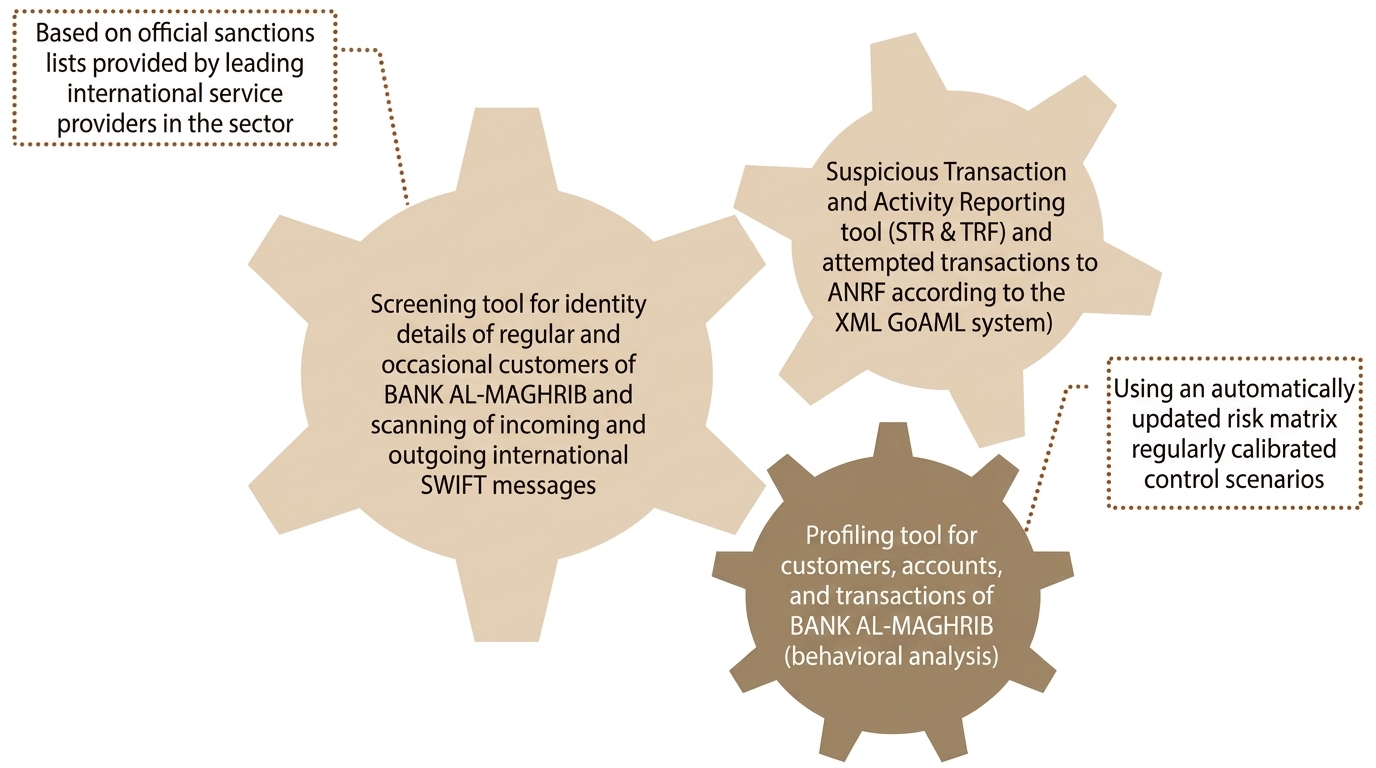
To fulfil its statutory obligations with regard to customer due diligence and the reporting of suspicious transactions, Bank Al-Maghrib has put in place information systems for risk management and decision support. These systems are subject to regular calibration, taking into account developments in identified money laundering and terrorist financing typologies, as well as international best practices.